Ivydene Gardens Stage 2 - Infill3 Plants Index Gallery: |
Ivydene Gardens Stage 2 - Infill3 Plants Index Gallery: |
||||||||
Botanical Plant Name with link to |
Flower Colour Sun Aspect of Full Sun, with link to external website for photo/data |
Flowering Months with link to |
Height with Spacings or Width (W) in inches (cms) 1 inch = |
Foliage Colour followed by with link to Australia or New Zealand mail-order supplier
with data for rows in |
Plant Type is:-
followed by:-
with links to |
Cultivation Details |
Varieties |
Plant Photos It is sad to reflect that in England so few gardens open to the public label their plants or label them so that the label is visible when that plant is in flower, so that visitors can identify; and then later locate and purchase that plant. Few mail-order nurseries provide the detail as shown in my rose or heather galleries. If you want to sell a product, it is best to display it. When I sold my Transit van, I removed its signage, cleaned it and took photos of the inside and outside before putting them onto an advert in Autotrader amongst more than 2000 other Transit vans - it was sold in 20 minutes. If mail-order nurseries could put photos to the same complexity from start of the year to its end with the different foliage colours and stages of flowering on Wikimedia Commons, then the world could view the plant before buying it, and idiots like me would have valid material to work with. I have been in the trade (until ill health forced my Sole Trader retirement in 2013) working in designing, constructing and maintaining private gardens for decades and since 2005 when this site was started, I have asked any nursery in the world to supply photos. R.V. Roger in Yorkshire allowed me to use his photos from his website in 2007 and when I got a camera to spend 5 days in July 2014 at my expense taking photos of his roses growing in his nursery field, whilst his staff was propagating them. I gave him a copy of those photos. |
Convallaria majalis (Lily of the Valley) |
|
|
|
|
|
Pot in October and November a good clump or hal-a-dozen plump single crowns in a 6 inch (15 cms) pot, using either loam, leaf-mould and well-rotted manure or John Innes compost for filling. Make sure that the pot is well drained. Keep the pot in the cool dark until January and then bring it into moderate heat. Water very sparingly, or when the compost needs it, until growth starts, and then water liberally. Flowering. Under normal room conditions, and by planting in October and November, flowering will be in January and February. Forcing. Lily of the Valley can be flowered almost continually throughout the year. For this purpose prepared crowns are necessary, which should be placed at 1-2 inches (2.5-5 cms) apart in either sand, sawdust or almost any material which will hold moisture. Before planting, the ends of the roots must be lightly trimmed. In planting, the tips of the buds must be kept just above the soil. After planting, the crowns should be well watered, making sure that the soil is thoroughly moist, and then kept in a dark, humid receptacle, such as a closed, ventilated box, for about 10 days at 70 degrees Fahrenheit (21 degrees Celsius). After 10 days they can be gradually exposed to light, and should flower in 2 weeks from that time. Once forced, crowns are of no further use. |
Majalis |
Convallaria majalis, Ruscaceae, Lily of the Valley, inflorescence; Karlsruhe, Germany. The fresh aerial parts of the blooming plant are used in homeopathy as remedy: Convallaria majalis (Conv.). By H. Zell via Wikimedia Commons. |
Cyclamen persicum (Persian cyclamen) The Cyclamen Society will provide further information. |
|
|
|
|
|
These Cyclamen can be grown from seed sown between August and November and then potted on. The principal seeding time is between October and November. From sowing till flowering time takes approximately 15-18 months. However, while to raise Cyclamen persicum from seed may be possible in the house, it is a long and exacting task and, therefore, not recommended. The simplest and most convenient way is to buy the potted plant either for growing-on or already in flower. It is not easily bought as a corm, and the best results are had from a seedling plant. Water. Watering is best carried out by standing the pot in a saucer, preferably of the earthenware type, and feeding the water into the saucer. If necessary, this should be done daily. Alternately, the pot may be stood upon a block of wood which is kept continually moist by being itself immersed in water. Fertiliser. When the first flower buds are seen, water in every 3-4 weeks a complete fertiliser. This will help the robustness and quality of the plant. Temperature. Cyclamen do not want excessive heat. More failures are caused by hot conditions than by any other reason(unless it be of bad watering). A temerature of from 50 degrees Fahrenheit (10 degrees Celsius) to 55 degrees Fahrenheit (13 degrees Celsius) is satisfactory, and provided sufficient humidity is created it is possible to have good results at temperatures varying from 45 degrees Fahrenheit (7 degrees Celsius) to 65 degrees Fahrenheit (18 degrees Celsius). Position. An east window, in full light, but not exposed to the glare or heat of the sun. |
Giant White Mont Blanc Perle Von Zehlendorf Pink Pearl Vuurbaak |
Cyclamen persicum. By Olei via Wikimedia Commons. |
|
|
North - Knows the points of the Compass. |
|
|
||||
|
|
North-facing |
|
|
||||
West - Woman |
West-facing |
House |
East-facing |
East - Every |
||||
|
|
South-facing |
|
|
||||
|
|
South - Silly |
|
|
||||
|
|
Flowering. They can be in flower from mid-November until March, depending upon the stage at which they are bought and the care with which they are tended. After flowering water should gradually be decreased and the corms kept in a cool, well-lighted place, but shielded from the full sun. So many corms are killed at this stage by allowing them to die of thirst. If allowed to dry out, the flower and leaf formation are severely checked or killed outright. They will give better results if allowed to remain in the same pots for up to 4 years or more. During the resting period enough humidity can be created by standing the pots on a tray of pebbles and water. At this time the corms can have plenty of fresh air, but not droughts. Thus it will be possible to have them in flower year after year. |
|
|
||||
Hyacinths - prepared (Dutch hyacinth, Hyacinthus orientalis) All parts of hyacinths, if ingested cause stomach upset and gloves should be worn when handling the bulbs as they may aggravate skin allergies. See the profile on harmful plants for more information. |
|
|
|
|
|
Pot 2 bulbs up to half their depth in a 6-inch (15 cms) or 3 in an 8-inch (20 cms) non-porous bowl or pan, using bulb fibre as potting medium. After potting, plunge in ashes or keep the pot in a dark cool place until the bulbs are well rooted. They can be brought to the light and warmth. Water. The bulb fibre should be kept moist at all times so that its consistency is always alive. Fertilisers. No fertilisers are needed when correctly mixed fibre is used. Temperature. Room heat is sufficient to bring prepared Hyacinths into early bloom, but they will stand a temperature of 70 degrees Fahrenheit (21 degrees Celsius) without showing undue signs of being forced. Position. South window with full light. Flowering. For pre-Christmas flowers prepared bulbs must be used, and for satisfactory flowering these should be from 17-18 cms as a minimum. For later flowering the same size of bulbs, but unprepared, will give the best flowers. After flowering the bulbs can be rested and planted in the garden. |
Prepared varieties:- Bismarck Delft Blue Dr. Leiber Dr. Streseman Jan Bos L'Innocence Marconi Unprepared Varieties:- Bismarck City of Haarlem Grand Maitre King of the Blues King of the Lilacs L'Innocence Lady Diamond Marconi Princess Margaret |
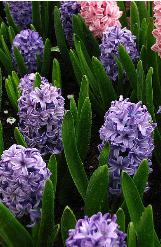
Flower beds in park Kolomenskoye (Moscow). Hyacinthus orientalis ‘Delft Blue’ Русский: Цветники в Коломенском (Москва). Гиацинт восточный ‘Delft Blue’. By Kor!An (Корзун Андрей) via Wikimedia Commons. |
Schizostylis (Kaffir Lily, Viscountess Byng, currently Hesperantha instead of Schizostylis) |
|
|
|
|
|
Pot from 4 to 5 tubers into a 5-inch (12.5 cms) pot in March. Compost should be John Innes or equal parts fibrous loam, peat, and 0.25 part fine sand. After potting the pot should be placed in a warm sunny position. Water liberally after potting and through the summer, but from autumn onwards reduce the water. Fertiliser. A complete fertiliser occasionally during summer. Temperature. 55-65 degrees Fahrenheit (13-18 degrees Celsius). Position. Full light in south window. |
coccinea Mrs Hegarty coccinea Viscountess Byng |
Schizostylus coccinea 'Mrs Hegarty'. By Wouter Hagens via Wikimedia Commons. |
|
|
|
|
|
|
|
|
|
From Explanation in Indoor Bulb Growing by Edward Pearson. Published by Purnell & Sons, Ltd in 1953:- More often than not introductions are never read. It is only quite recently that I have found their worth and realised that little is gained and much lost by skipping this part of a book, which may appear uninteresting and unnecessary, in order to hurry to the pith of the matter. It may well be that I shall be served in the same way. The purpose of this introduction is to make clear certain of the operations and duties which are only briefly mentioned in the notes. In addition, other information is given which will be of value to the indoor gardener. Thus an attempt is made to satisfy the needs of the beginner so that he will not, at any time, have to pause in his bulb work, whether planting, watering or plunging, in order to ask himself what he should do next. That is the purpose for which these notes were started. But before they were finished another purpose had grown up. This was the hope that in following the simple instructions and by reading through the lists of bulbs that can so easily be grown in the house there would awake in the reader's heart a wish to extend the range of bulbs at present grown in pots and bowls. Apart from giving details for indoor bulb growing, I feel it necessary to explain quite clearly that the main purpose in compiling these notes is to show that with a little trouble and ingenuity an interesting and delightful sucession of flowers can be raised by the person who has neither greenhouse nor frame, but merely the room or rooms in which he lives. Naturally, a greenhouse or frame will simplify the cultivations needed, but such aids are not a vital factor for success. So then, as I have put the householder first in importance and have pictured him with nothing more than the rooms in which he lives, I have now to assume that such rooms, from late autumn until early spring, are kept heated at temperatures sometimes described as within the comfort region, that is between 50-60 degrees Fahrenheit (10-16 degrees Celcius). For if this is comfort for humans it is also, in the main, comfort for plants. By what means this happy condition is obtained has not troubled me; I have merely assumed its existence. Central heating, gas, coal fires or electricity will obviously all take their share; and while it is no purose of mine to pose as a heating engineer, I have a particular liking for the modern convector fires, which, along with central heating, have the great advantage that they will burn continuously and so avaid the damaging drop in temperature at nights. In addition, convector fires are, room by room, more cheaply fuelled than a radiator system. Gas, for either heat or light, is deadly to most plants; but whether it is particularly so to bulbous plants, I do not know. I would certainly not take the risk of trying to grown any expensive or even moderately delicate kinds in rooms heated or lighted by gas. I have used the word bulb to describe the varied bulbous plants which are noted later. To be accurate, they are not all bulbs, but corms and tubers as well, or merely rhizomes. For the sake of simplicity rather than botanical accuracy, and so for clarity in this instance, the word bulb must do as an overall name for this group of plants. Yet, because there is some satisfaction in accuracy and knowledge, even when no particular advantage may be gained, it is well that there should be a definition of the various classes of bulbous plants. A bulb is of 2 kinds:
A tuber is also an underground stem, composed not of scales but of a solid mass of cells capable of storing food with which to supply the eyes when growth starts. The grouping of the eyes varies from variety to variety. A bulb has roots which grow from one place only, while a tuber will send out roots from many parts of its surface. As examples, Eranthis and Begonias are tubers. A corm is a mixture between the bulb and tuber, having a solid cell structure as with the latter, but sending out roots from one point only as with the former. The eyes in a corm are not so haphazardly distributed as in the tuber, Anemones, Cyclamen, Crocus and Gladioli are corms. The Cyclamen, however, unlike the others mentioned, is a perennial corm, growing new flowers and leaves, etc, each year, while Anemones, Gladioli, etc, propagate by means of offsets grown each year. Although nobody will deny that all matters of growing and all things connected with the soil require care and patience, ver few persons, when the time comes for them to try their hand, will realise that these requirements are as important in their own case as in the next man's. Patience and care are the virtues which must grace every operation to do with growing, whether of the smallest seed or of a forest tree. These are the qualities which lie in a green hand and are as important as knowledge itself. So long as certain simple facts are learned and the 2 virtues are enjoyed, the grower can be certain of achieving reasonable success. The rules of good husbandry apply as much in the living-room as in the field, and full knowledge will come through experience rather than reading. The house plant, which is constantly under the eye, lends itself to greater interest and study than the plant in the garden. From such study common sense will build up a store of practical knowledge. A Geranium, a Hyacinth, a Fern and a few Trumpet Daffodils are the plants which come to the mind of the average person when talking of house plants. In fact there are at least 1000 varieties in 1953 which can be successfully grown under normal living-room conditions, or in a sun-porch or window-box. I have chosen to deal only with bulbs because of their greater variety and greater charm. A glance at these 12 Calendar pages will show that throughout most of the year colour and fragrance can fill the house, particularly during the winter months. The usual month for flowering in the Calendar of Bloom Pages has been given, but, naturally, at the end of each month the flowers do not die and new kinds take their place. In most cases the flowering period overlaps, while, dependent on the time potted, certain bulbs can be flowered in successive months - for instance,
However, it is improbable (and also impractical) that a householder would be eager enough to continue with the same subject in such succession. Once the plant has flowered he is more likely to turn his hand to a fresh type. Most gardeners have their favourite flowers. This is also true of the indoor gardener. For myself, each season I find it impossible to favour one kind more than another. As each month brings its various flowers, so each month brings a pleasing anticipation and admiration, and when this colourful procession has passed I find it impossible to say which section has been most enjoyed. As much for this reason as for that of my own inadequacy, I have not made any attempt to give rhapsodic and poetical descriptions to the plants covered by these notes. I have been unable to press the claims of one above any other. For, holding the opnion that the average householder grows a very limited range of bulbs, the fact that by reading my suggestions he will extend this range may effect the same result as possibly that of the adjectives which I have avoided. If this should be so, then the grower will at least understand my descriptive inability. But I cannot miss this chance to chastise many gardeners who will neither grow the hardy Nerines because they think them unhardy nor the autumn-flowering Crocuses and Colchicums because they do not know about them. Their ignorance cannot be forgiven, because each year, around planting time, articles on the autumn-flowering bulbs are written in the gardening papers. But if they not read such papers, then there are many helful catalogues issued each year by nurserymen and bulb importers which will tell the ignorant enough about autumn-flowering bulbs and their culture to make at least a start. What is wanted is a more adventurous approach to such catalogues. Too often only what is well known is grown. As one of the main objects in compiling these notes has been to stir up interest and enterprise within the home, I can see no reason to withold such criticism of the outside gardener. Some of these rarely seen bulbs are the autumn-flowering Crocuses and the Nerines. All these are quite hardy, easy to grow, and of immense value in the fall. Many confuse the Colchicums with the Autumn Crocuses, but care in the reading of the nurseryman's autumn bulb catalogue will soon clear away such confusion. One or two of the Autumn Crocuses are mentioned later as house plants, others well worth while for the garden are:
As a class, the Nerines are often thought to be tender plants. When the right types, such as Bowdeni, are planted they will be found capable of standing up to a severe winter, and in October their flowers will amply repay the little trouble they give. It is obviously impossible to give illustrations that do justice to all the varieties described in the following notes, but a series of visits to the Royal Horticultural Society Hall during the spring and autumn, when most of them are exhibited, will do far more than either descriptive ability or illustrations to extend the present range of indoor bulbs.
BUYING BULBS A most important factor for successful bulb culture is the size and quality of the bulbs used. The large-size bulbs do not necessarily give the best flowers. There is, of course, in the buying of the largest sizes a sense of precautionary insurance, which gives excuse for the extra spending involved. There may also be an element of snobbery in this habit. Undoubdtely the largest bulbs give good-quality flowers, but then so do many of the smaller sizes. In fact some bulbs will give better results in the smaller sizes, such as Anemone Coronaria, while with the Gladioli exhibition blooms can be grown from corms of 8-9 cms in circumference. When the harvesting is over, bulbs are graded into various sizes, the top 2 sizes being generally set aside for sale and the smaller sizes being replanted. The classifications by which sizes of bulbs and corms are recognised vary according to the type of bulb or corm;-
For indoor use the following sizes are the best:
in some cases 2 sizes have been given, and where this is so it is probable that the best flowers will grow from the greater size of bulb, but the smaller size will give satisfactory results. As the price increase with the size of the bulb, the choice of larger or smaller must be left to the pocket. There is an exception to these sizes in the case of certain varieties within the same family. For instance, some varieties of Tulips, such as doubles, will flower well from seedling sizes, while in Narcissi the varieties Actaea Ornatus, Firetail, Peeping Tom and February Gold make a smaller top-size bulb than other varieties. When a Hyacinth bulb is reffred to as "prepared", it means that after harvesting it is subjected to some weeks of heat treatment. The effect of such heating before forcing is to induce the bulb to flower considerably earlier than if it is merely lifted and then forced. The opposite treatment is given to Narcissi, Tulips and Lily of the Valley, which are cold-stored before being forced for early flowering. Conversely, by hot-air treatment, such bulbs as last mentioned can be retarded so that they will flower long after the normal outdoor season. It is quite true that with such treatment a Narcissus can be had in flower during every month of the year, although there seems little benefit thus gained. After the heat treatment the Hyacinth should be planted as soon as possible. But practically all Hyacinths are imported into this country to shops and nurserymen, and this means that at the very best there is bound to be some long time-lag between preparation and potting. The longer the delay and the more the bulbs are exposed to warm conditions, the less the effect of the preparation and so the later the bulb will flower. Generally, the imports are made at the end of September, when ordering and potting for early flowering should be done. If early flowers are wanted, there is little point in buying prepared Hyacinths after mid-October; unprepared bulbs will be just as satisfactory and cheaper, even if some were prepared are still obtainable. |
||||||||
PLANTING The best-quality flowers can be got by providing the bulbs from planting time with the best possible conditions - namely:
The ideal potting mixture should come up to the following standards:
For general house work, particularly when there is no garden, the simplest, cleanest potting medium for Narcissi, Tulips, Crocuses, Lily of the Valley and Hyacinths is the standardised bulb fibre which is obtainable from horticultural sundriesmen. It is composed of shredded peat, charcoal, some sand and so-called oyster shell. The peat retains moisture, the charcoal counteracts any acidity from the peat, and the shell is reputed to keep the peat open and friable. When bulb fibre is used it is best to soak it thoroughly for about 24 hours before planting. If the grower prefers to make up his own potting medium instead of buying bulb fibre, the recipes are given for such mixtures in the notes. Certain bulbs will, however, give better results if potted into John Innes Compost No. 2 and not bulb fibre. This compost is made up from the following materials:
These are sterilised, then mixed, and to them is added both lime and superphosphate, making a good potting medium for bulbs, although the mixture is specifically designed for plants (I think that the addition of Seaweed meal would then also provide the correct balance of trace elements). Here is a list of those which will succeed best in either the fibre or the John Innes Compost respectively: |
||||||||
BULB FIBRE |
|
|
|
|
|
|
|
|
Crocuses |
Chionodoxa |
Fritillaria meleagris |
Galanthus |
Hyacinths |
Narcissi and Daffodils |
Tulips |
|
|
JOHN INNES POTTING COMPOST |
|
|
|
|
|
|
|
|
Achimenes |
Agapanthus |
Allium |
Amaryllis |
Brodiaea |
Calla |
Colchicum |
Convallaria |
Crinum |
Cyclamen persicum |
Eranthis |
Freesias |
Gladiolus colvillei |
Iris reticulata |
Lachenalias |
Ixias |
Muscari |
Nerine |
Ornithogalum |
Puschkinia |
Scilla |
Sparaxis |
Sternbergia lutea |
Vallota |
|
|
|
As these are general and important observations which are relevant not only to one but to a great many classes of bulbs, the exact details for planting - such as the time of year, depth, etc (You would not believe the importance of the enveloping word "etc" as I tell my 68 year old friend who is a girl - She is very independently minded, so not allowing me to call her my girlfriend - of my regard for her by saying that it is because of her charm, wit and something else. Who said that romance has finally fled the scene!) - have been included in the notes. Under the heading of planting some information is also necessary about the types of bowls and pots used, but their shape and colour, and to some extent their size, must naturally rest with the grower, who should, when using a coloured bowl, remember the colour of the flowers which will eventually bloom in that particular bowl. The points for a beginner are:
Whatever the bowl - so long as the soil is not bulb fibre - it is best to have drainage holes at the base; if it has not, then adequate crocking (pieces of broken floer-pots), pebbles or stones should be put at the bottom of the container, through which surplus water can drain. If such crocking is not provided, the soil will become waterlogged - a state extremely difficult to cure and which, more often than not, leads to the base of the bulb becoming rotten. In short, when there is likelihood of the potting medium rapidly drying out a non-porous vessel should be used; but when there is a possibility of waterlogging, then a porous vessel with drainage facilities must be used. In planting up bowls devote 1 variety of a particular kind to 1 bowl, because mixtures will flower at different times and heights. For a guiding principle, as many bulbs as possible should be planted in the receptacle, providing the bulbs do not touch each other, each bulb being firmly seated and with its snout sticking out from the compost. After planting, 0.5 inch (1.25 cms) must be left between the top of the soil and the top of the bowl or pot so as to allow room for watering and to prevent water from spilling over. Recommendations made later concerning the number of bulbs planted in a pot or bowl should be taken as guides rather than hard-and-fast rules. This question can be left to the judgement of the grower, who should remember that the best effect will be from a generous planting. The smaller the bulb, the closer the planting. |
||||||||
PLUNGING Plunging the planted bulbs is necessary because ligfht is thus shut off from them and root growth will start before leaf growth. This will make certain that when the leaves and flowers grow they will have a strong root system through which to obtain their nourishment. A bulb which is grown without being planted at the proper depth will throw out leaves and develop a weak and rudimentary root system. Thus the act of putting the bowls of bulbs in the dark until they are well rooted takes the place in garden work of planting at a proper depth. When there is no frame available, 1 of 2 methods can be satisfactorily used:
If neither of these suggestions is of use, the bulbs, after planting, can be well-covered with brown paper to prevent the light from reaching them, and the bowls kept where most convenient. Whichever method is used, the temperature should remain as normal as possible and extremes should be avoided. As soon as about 2-3 inches (5-75 cms) of leaf growth appears, the bulbs can be brought into full light. If there is any doubt whether a bulb has rooted, then it can be gently moved by hand to feel if it well anchored. If still in doubt, leave it where it is. |
||||||||
ON WATERING AND TEMPERATURES Temperature is obviously closely related to air humidity; for the higher the temperature, the dryer the atmosphere, and so the greater the need to give a humid atmosphere or to water the plants. The greater the number of plants in a room, the greater is the humidity created; But if there is doubt upon this point, a pan of water, standing by the source of heat or elsewhere in the room, will help to raise the humidity. Thus, where plants are kept in the cool, the need to water is less; the warmer the conditions, the greater the need to water. For the routine of watering there is but 1 rule, which is to keep the plant supplied with sufficient moisture so that shall be in a state of continual and unchecked growth until after flowering. The leaves and flowers should never flag, and the soil should, as a general rule, be continually in that state to which horse-lovers and rabbit-keepers delight to mix bran mashes - that is, alive. A good guide is to take some of the potting material in one's hand and slightly squeeze it. If, on relaxing one's grip, the mixture binds, then it just right. On the other hand, if too wet, the excess moisture will escape through the clenched fingers. Providing that the grower knows something of the plants which he is tending - that is to say, whether as a race they are water-loving, as the Azalea Indica, or whether, like the Nerines and Freesias, their water demands are seasonal - then the details can be left to his common sense. The most important principle is not the regularity of watering but the regular round of inspection to see what may be needed. This must be a most carefully observed routine, for the reason that the temperature of the average living-room must vary considerably (unlike a greenhouse where the entire purpose is the maintenance of an even temperature),and consequently the water and humidity needs of the room-plants will vary from day to day. The watering must, therefore, never be left for certain hours on certain days but must be carried out when needed. |
||||||||
TEMPERATURE |
||||||||
Eranthis |
Chionodoxa |
Fritillaria meleagris |
Galanthus |
Iris reticulata |
Muscari |
Ornithogalum |
Miniature Narcissi |
Scilla |
Vallota |
|
|
|
|
|
|
|
|
LIGHT The pots of bulbs must be turned regularly so that the plants shall not grow to 1 side only. At all times the maximum top light should be provided, although this is the most difficult to give. In an effort to fill the bulbs' need for light, some discretion is wanted to prevent the plants from becoming scorched by being too near the window glass on a sunny day. |
||||||||
STAKING Obviously the purpose is to provide support in as inconspicuous a way as possible. Thin sticks must therefore be used. Halved bamboo canes, special metal rods, or, for certain bulbs such as Freesias, Ixias, Sparaxis or those with rush-like foliage, hazel twigs can be used. The ties should be made with raffia. |
||||||||
AFTER FLOWERING With the 2 exceptions mentioned above and the stipluation that the bulb has not been unduly forced, the treatment to give is in principle the same for all varieties. After flowering comes the dying down and the resting period, of varying length, which is followed in turn by the growing period. During the resting time a bulb is building up reserves of food, increasing its size or that of any offsets, and developing the future stem and flower. Once the flowers are dead the leaves start to die down. The slower the rate at which the leaves die, the better the quality of the bulb when it starts into growth again. Therefore, at that stage, watering should not be abruptly stopped, as is generally the case, but should be gradually discontinued over as long a time as possible. In fact, watering at the dying-down stage should be a step behind the plant's progress to rest - just sufficient to keep it awake for a little longer - so that it finishes its cycle naturally and is not killed through lack of water. When the leaves are dead and brown the bulb may be lifted and allowed to rest in a box of peat until planting time, dependent upon the type. Where there is a garden or space available in the house, the bulbs can be left in the bowls until it is time to replant them, providing that they receive enough moisture from time to time. Certain bulbs object to being moved, however, and in these cases it is wiser to leave them undisturbed. A typical example is that of the miniature Narcissi, which, when once potted, should remain undisturbed in the pots for at least 2 to 3 years. It will be found that when this is done the flowers are far more satisfactory in the second and third years than in the first. |
||||||||
BULBS AND CORMS WHICH CAN BE REPOTTED FOR USE EACH YEAR |
|
|
|
|||||
Allium neapolitanum |
Arums |
Begonias |
Brodiaea |
Brodiaea uniflora |
Daffodils |
Eranthis |
Freesias |
Gladiolus nanus and Byzantinus |
Hyacinths |
Ixias |
Lachenalias |
Muscari |
Ornithogalum |
Sparaxis |
Tritonia |
|
|
BULBS WHICH SHOULD REMAIN IN THE POTS FROM 2 TO 3 YEARS AT LEAST |
|
|
|
|||||
Achimenes |
Amaryllis |
Agapanthus |
Allium karataviense |
Cochicum |
Crinum |
Crocus species |
Fritillaria |
Galanthus (3 years) |
Iris species |
Lilies |
Cyclamen persicum |
Liriope |
Miniature Narcissi |
Nerine |
Polygonatum |
Schizostylis |
Scillas |
Sterbergia lutea |
Tulip species |
Vallota |
Zephyranthes |
|
|
|
|
|
|
|
|
|
|
|
|
|
|
|
|
|
|
|
|
|
|
|
|
|
|
|
|
|
|
|
|



STAGE 2 |
STAGE 1 GARDEN STYLE INDEX GALLERY PAGES Links to pages in Table alongside on the left with Garden Design Topic Pages |
||||||||||||||||||||||||||||||||||||||||||||||||||||||||||||||||||||||||||||||||||||||||||||||||||||||||||||||||||||||||||||||||||||||||||||||||||||||||||||||||||||||||||||||||||||||||||||||||||||||||||
Plant Type |
STAGE 2 INFILL PLANT INDEX GALLERIES 1, 2, 3 with its Cultivation Requirements |
||||||||||||||||||||||||||||||||||||||||||||||||||||||||||||||||||||||||||||||||||||||||||||||||||||||||||||||||||||||||||||||||||||||||||||||||||||||||||||||||||||||||||||||||||||||||||||||||||||||||||
Alpines for Rock Garden (See Rock Garden Plant Flowers) |
Alpines and Walls |
||||||||||||||||||||||||||||||||||||||||||||||||||||||||||||||||||||||||||||||||||||||||||||||||||||||||||||||||||||||||||||||||||||||||||||||||||||||||||||||||||||||||||||||||||||||||||||||||||||||||||
Aquatic |
Water-side Plants |
Wildlife Pond Plants |
|||||||||||||||||||||||||||||||||||||||||||||||||||||||||||||||||||||||||||||||||||||||||||||||||||||||||||||||||||||||||||||||||||||||||||||||||||||||||||||||||||||||||||||||||||||||||||||||||||||||||
Annual for ----------------
|
Cut Flowers |
||||||||||||||||||||||||||||||||||||||||||||||||||||||||||||||||||||||||||||||||||||||||||||||||||||||||||||||||||||||||||||||||||||||||||||||||||||||||||||||||||||||||||||||||||||||||||||||||||||||||||
Scent / Fra-grance with Annuals for Cool or Shady Places from 1916 |
Low-allergen Gardens for Hay Fever Sufferers |
Annual Plant Pairing Ideas and Colour Schemes with Annuals |
Medium-Growing Annuals |
Tall-Growing Annuals with White Flowers from 1916 |
|||||||||||||||||||||||||||||||||||||||||||||||||||||||||||||||||||||||||||||||||||||||||||||||||||||||||||||||||||||||||||||||||||||||||||||||||||||||||||||||||||||||||||||||||||||||||||||||||||||||
Black or Brown Flowers |
Blue to Purple Flowers |
Green Flowers with Annuals and Biennials from 1916 |
|||||||||||||||||||||||||||||||||||||||||||||||||||||||||||||||||||||||||||||||||||||||||||||||||||||||||||||||||||||||||||||||||||||||||||||||||||||||||||||||||||||||||||||||||||||||||||||||||||||||||
Vining Annuals |
|
||||||||||||||||||||||||||||||||||||||||||||||||||||||||||||||||||||||||||||||||||||||||||||||||||||||||||||||||||||||||||||||||||||||||||||||||||||||||||||||||||||||||||||||||||||||||||||||||||||||||||
Bedding for |
Bedding for Light Sandy Soil |
Bedding for Acid Soil |
Bedding for Chalky Soil |
Bedding for Clay Soil |
|||||||||||||||||||||||||||||||||||||||||||||||||||||||||||||||||||||||||||||||||||||||||||||||||||||||||||||||||||||||||||||||||||||||||||||||||||||||||||||||||||||||||||||||||||||||||||||||||||||||
Attract-ive to Wildlife including Bees, Butterflies and Moths |
|||||||||||||||||||||||||||||||||||||||||||||||||||||||||||||||||||||||||||||||||||||||||||||||||||||||||||||||||||||||||||||||||||||||||||||||||||||||||||||||||||||||||||||||||||||||||||||||||||||||||||
Bedding Plant Use |
|||||||||||||||||||||||||||||||||||||||||||||||||||||||||||||||||||||||||||||||||||||||||||||||||||||||||||||||||||||||||||||||||||||||||||||||||||||||||||||||||||||||||||||||||||||||||||||||||||||||||||
Use in Hanging Baskets |
|||||||||||||||||||||||||||||||||||||||||||||||||||||||||||||||||||||||||||||||||||||||||||||||||||||||||||||||||||||||||||||||||||||||||||||||||||||||||||||||||||||||||||||||||||||||||||||||||||||||||||
Flower Simple Shape |
Shape of |
Shape of |
Shape of |
Shape of |
Shape of |
Use in Pots and Troughs |
|||||||||||||||||||||||||||||||||||||||||||||||||||||||||||||||||||||||||||||||||||||||||||||||||||||||||||||||||||||||||||||||||||||||||||||||||||||||||||||||||||||||||||||||||||||||||||||||||||||
Flower Elabo-rated Shape |
Shape of |
Shape of |
Shape of |
|
Use in |
Use in |
|||||||||||||||||||||||||||||||||||||||||||||||||||||||||||||||||||||||||||||||||||||||||||||||||||||||||||||||||||||||||||||||||||||||||||||||||||||||||||||||||||||||||||||||||||||||||||||||||||||
Shape of |
Shape of |
Shape of |
Shape of |
|
Use in Bedding Out |
Use in |
|||||||||||||||||||||||||||||||||||||||||||||||||||||||||||||||||||||||||||||||||||||||||||||||||||||||||||||||||||||||||||||||||||||||||||||||||||||||||||||||||||||||||||||||||||||||||||||||||||||
Biennial for |
Patio Con-tainers with Biennials for Pots in Green-house / Con-servatory |
Bene-ficial to Wildlife with Purple and Blue Flowers from 1916 |
|
|
|||||||||||||||||||||||||||||||||||||||||||||||||||||||||||||||||||||||||||||||||||||||||||||||||||||||||||||||||||||||||||||||||||||||||||||||||||||||||||||||||||||||||||||||||||||||||||||||||||||||
Bulb for |
Indoor Bulbs for Sep-tember |
Bulbs in Window-boxes |
|||||||||||||||||||||||||||||||||||||||||||||||||||||||||||||||||||||||||||||||||||||||||||||||||||||||||||||||||||||||||||||||||||||||||||||||||||||||||||||||||||||||||||||||||||||||||||||||||||||||||
Any Plant Type (some grown in Cool Green-house) Bloom-ing in |
Any Plant Type (some grown in Cool Green-house) Bloom-ing in |
Any Plant Type (some grown in Cool Green-house) Bloom-ing in |
Any Plant Type Blooming in Smallest of Gardens |
||||||||||||||||||||||||||||||||||||||||||||||||||||||||||||||||||||||||||||||||||||||||||||||||||||||||||||||||||||||||||||||||||||||||||||||||||||||||||||||||||||||||||||||||||||||||||||||||||||||||
Bulbs in Green-house or Stove |
Achi-menes, Alocasias, Amorpho-phalluses, Aris-aemas, Arums, Begonias, Bomar-eas, Calad-iums |
Clivias, |
|||||||||||||||||||||||||||||||||||||||||||||||||||||||||||||||||||||||||||||||||||||||||||||||||||||||||||||||||||||||||||||||||||||||||||||||||||||||||||||||||||||||||||||||||||||||||||||||||||||||||
Hardy Bulbs
|
Amaryllis, Antheri-cum, Antholy-zas, Apios, Arisaema, Arum, Aspho-deline, |
Cyclamen, Dicentra, Dierama, Eranthis, Eremurus, Ery-thrnium, Eucomis |
Fritillaria, Funkia, Gal-anthus, Galtonia, Gladiolus, Hemero-callis |
Hya-cinth, Hya-cinths in Pots, |
|||||||||||||||||||||||||||||||||||||||||||||||||||||||||||||||||||||||||||||||||||||||||||||||||||||||||||||||||||||||||||||||||||||||||||||||||||||||||||||||||||||||||||||||||||||||||||||||||||||||
|
Lilium in Pots, Malvastrum, Merendera, Milla, Narcissus, Narcissi in Pots |
Half-Hardy Bulbs |
Gladioli, Ixias, |
Plant each Bedding Plant with a Ground, Edging or Dot Plant for |
||||||||||||||||||||||||||||||||||||||||||||||||||||||||||||||||||||||||||||||||||||||||||||||||||||||||||||||||||||||||||||||||||||||||||||||||||||||||||||||||||||||||||||||||||||||||||||||||||||||||
Climber 3 sector Vertical Plant System with
---------- |
1a. |
1b. |
|
||||||||||||||||||||||||||||||||||||||||||||||||||||||||||||||||||||||||||||||||||||||||||||||||||||||||||||||||||||||||||||||||||||||||||||||||||||||||||||||||||||||||||||||||||||||||||||||||||||||||
2b. |
3a. |
3c. |
Raised |
Plants for Wildlife-Use as well |
|||||||||||||||||||||||||||||||||||||||||||||||||||||||||||||||||||||||||||||||||||||||||||||||||||||||||||||||||||||||||||||||||||||||||||||||||||||||||||||||||||||||||||||||||||||||||||||||||||||||
Least prot-ruding growth when fan-trained |
|||||||||||||||||||||||||||||||||||||||||||||||||||||||||||||||||||||||||||||||||||||||||||||||||||||||||||||||||||||||||||||||||||||||||||||||||||||||||||||||||||||||||||||||||||||||||||||||||||||||||||
Needs Conserv-atory or Green-house |
|||||||||||||||||||||||||||||||||||||||||||||||||||||||||||||||||||||||||||||||||||||||||||||||||||||||||||||||||||||||||||||||||||||||||||||||||||||||||||||||||||||||||||||||||||||||||||||||||||||||||||
Climber - Simple Flower Shape |
|
||||||||||||||||||||||||||||||||||||||||||||||||||||||||||||||||||||||||||||||||||||||||||||||||||||||||||||||||||||||||||||||||||||||||||||||||||||||||||||||||||||||||||||||||||||||||||||||||||||||||||
Climber - Elaborated Flower Shape |
|||||||||||||||||||||||||||||||||||||||||||||||||||||||||||||||||||||||||||||||||||||||||||||||||||||||||||||||||||||||||||||||||||||||||||||||||||||||||||||||||||||||||||||||||||||||||||||||||||||||||||
|
|||||||||||||||||||||||||||||||||||||||||||||||||||||||||||||||||||||||||||||||||||||||||||||||||||||||||||||||||||||||||||||||||||||||||||||||||||||||||||||||||||||||||||||||||||||||||||||||||||||||||||
|
|||||||||||||||||||||||||||||||||||||||||||||||||||||||||||||||||||||||||||||||||||||||||||||||||||||||||||||||||||||||||||||||||||||||||||||||||||||||||||||||||||||||||||||||||||||||||||||||||||||||||||
|
|||||||||||||||||||||||||||||||||||||||||||||||||||||||||||||||||||||||||||||||||||||||||||||||||||||||||||||||||||||||||||||||||||||||||||||||||||||||||||||||||||||||||||||||||||||||||||||||||||||||||||
|
|||||||||||||||||||||||||||||||||||||||||||||||||||||||||||||||||||||||||||||||||||||||||||||||||||||||||||||||||||||||||||||||||||||||||||||||||||||||||||||||||||||||||||||||||||||||||||||||||||||||||||
|
DISCLAIMER: Links to external sites are provided as a courtesy to visitors. Ivydene Horticultural Services are not responsible for the content and/or quality of external web sites linked from this site. |
||||||||||||||||||||||||||||||||||||||||||||||||||||||||||||||||||||||||||||||||||||||||||||||||||||||||||||||||||||||||||||||||||||||||||||||||||||||||||||||||||||||||||||||||||||||||||||||||||||||||||
Scented Flora of the World by Roy Genders - was first published in 1977 and this paperback edition was published on 1 August 1994 ISBN 0 7090 5440 8:- |
|||||||||||||||||||||||||||||||||||||||||||||||||||||||||||||||||||||||||||||||||||||||||||||||||||||||||||||||||||||||||||||||||||||||||||||||||||||||||||||||||||||||||||||||||||||||||||||||||||||||||||
I am using the above book from someone who took 30 years to compile it from notes made of his detailed observations of growing plants in preference to |
|||||||||||||||||||||||||||||||||||||||||||||||||||||||||||||||||||||||||||||||||||||||||||||||||||||||||||||||||||||||||||||||||||||||||||||||||||||||||||||||||||||||||||||||||||||||||||||||||||||||||||
The Propagation of Alpines by Lawrence D. Hills. Published in 1950 by Faber and Faber Limited describes every method of propagation for 2,500 species. Unlike modern books published since 1980, this one states exactly what to do and is precisely what you require if you want to increase your alpines. |
|||||||||||||||||||||||||||||||||||||||||||||||||||||||||||||||||||||||||||||||||||||||||||||||||||||||||||||||||||||||||||||||||||||||||||||||||||||||||||||||||||||||||||||||||||||||||||||||||||||||||||



Topic |
|
|
|
STAGE 4C CULTIVATION, POSITION, USE GALLERY
Cultivation Requirements of Plant |
|
Outdoor / Garden Cultivation |
|
Indoor / House Cultivation |
|
Cool Greenhouse (and Alpine House) Cultivation with artificial heating in the Winter |
|
Conservatory Cultivation with heating throughout the year |
|
Stovehouse Cultivation with heating throughout the year for Tropical Plants |
|
|
|
Sun Aspect |
|
|
|
Soil Type |
|
|
|
Soil Moisture |
|
|
|
Position for Plant |
|
Ground Cover 0-24 inches (0-60 cms) |
|
Ground Cover 24-72 inches (60-180 cms) |
|
Ground Cover Over 72 inches (180 cms) |
|
1, 2, |
|
|
|
Use of Plant |
|
|
|
STAGE 4D Plant Foliage |
|
|
|
Flower Shape |
|
Number of Flower Petals |
|
|
|
Flower Shape - Simple |
|
|
|
|
|
|
Flower Shape - Elaborated |
|
|
|
Natural Arrangements |
|
|
|
STAGE 4D |
|
|
|
|
|
Form |
|
|
|
|
|
STAGE 1
Fragrant Plants adds the use of another of your 5 senses in your garden:- |
|
|
|
STAGE 2 Fan-trained Shape From Rhododendrons, boxwood, azaleas, clematis, novelties, bay trees, hardy plants, evergreens : novelties bulbs, cannas novelties, palms, araucarias, ferns, vines, orchids, flowering shrubs, ornamental grasses and trees book, via Wikimedia Commons |
|
Ramblers Scramblers & Twiners by Michael Jefferson-Brown (ISBN 0 - 7153 - 0942 - 0) describes how to choose, plant and nurture over 500 high-performance climbing plants and wall shrubs, so that more can be made of your garden if you think not just laterally on the ground but use the vertical support structures including the house as well. The Gardener's Illustrated Encyclopedia of Climbers & Wall Shrubs - A Guide to more than 2000 varieties including Roses, Clematis and Fruit Trees by Brian Davis. (ISBN 0-670-82929-3) provides the lists for 'Choosing the right Shrub or Climber' together with Average Height and Spread after 5 years, 10 years and 20 years. |
|
|
|
STAGE 2
|
|
|
|
STAGE 4D Trees and Shrubs suitable for Clay Soils (neutral to slightly acid) Trees and Shrubs suitable for Dry Acid Soils Trees and Shrubs suitable for Shallow Soil over Chalk Trees and Shrubs tolerant of both extreme Acidity and Alkalinity Trees and Shrubs suitable for Damp Sites Trees and Shrubs suitable for Industrial Areas Trees and Shrubs suitable for Cold Exposed Areas Trees and Shrubs suitable for Seaside Areas Shrubs suitable for Heavy Shade Shrubs and Climbers suitable for NORTH- and EAST-facing Walls Shrubs suitable for Ground Cover Trees and Shrubs of Upright or Fastigiate Habit Trees and Shrubs with Ornamental Bark or Twigs Trees and Shrubs with Bold Foliage Trees and Shrubs for Autumn Colour Trees and Shrubs with Red or Purple Foliage Trees and Shrubs with Golden or Yellow Foliage Trees and Shrubs with Grey or Silver Foliage Trees and Shrubs with Variegated Foliage Trees and Shrubs bearing Ornamental Fruit Trees and Shrubs with Fragrant or Scented Flowers Trees and Shrubs with Aromatic Foliage Flowering Trees and Shrubs for Every Month:- |
|


_01.JPG)

.jpg?uselang=en-gb)
Copied from |
||||||||||||||||||||||||||||||||||||||||||||||||||||||||||||||||||||||||||||||||||||||||||||||||||||||||||||||||||||||||||||||||||||||||||||||||||||||||||||||||||||||||||||||||||||||||||||||||||||||||||||||||||||||||||||||||||||||||||||||||||||||||||||||||||||||||||||||||||||||
Soil contains living material that requires the right structure and organic material to provide food for plants. If the structure of the soil tends towards a loam of about 20-50% sand, silt and 20 - 40% clay with a pH between 6 and 7.5, then this suitable for a high proportion of plants. Otherwise an application of a mulch of sand and horticultural grit for clay, or clay and horticultural grit for sand, is required to improve plant growth. If an annual mulch of organic material (Spent Mushroom Compost, Cow Manure, Horse Manure does contain weed seeds and should only be used under hedges or ground-covering trees/shrubs) is applied of 100mm (4”) thickness to the soil, then the living material in the soil can continue their role of feeding the plants. This mulch will stop the ground drying out due to wind or sun having direct access to the ground surface. The annual loss of organic matter from soils in cool humid climates is about 6lbs per square metre. If there is also a drip-feed irrigation system under the mulch (which is used for 4 continuous hours a week - when there is no rain that week from April to September), then the living material can get their food delivered in solution or suspension. If the prunings from your garden are shredded (or reduced to 4” lengths) and then applied as a mulch to your flower beds or hedges, followed by 0.5” depth of grass mowings on top; this will also provide a start for improvement of your soil. The 0.5" layer can be applied again after a fortnight; when the aerobic composting stage (the aerobic composting creates heat and 0.5" - 1 cm - thickness does not become too hot to harm the plants next to it) has been completed during the summer. Anaerobic (without using air) composting then completes the process. Application of Seaweed Meal for Trace Elements and other chemicals required to replenish what has been used by the plants in the previous year for application in Spring are detailed in the How are Chemicals stored and released from Soil? page.
You normally eat and drink at least 3 times every day to keep you growing, healthy and active; plants also require to eat and drink every day. Above 5 degrees Celcius plants tend to grow above ground and below 5 degrees Celcius they tend to grow their roots underground. 2 minor points to remember with their result-
|
||||||||||||||||||||||||||||||||||||||||||||||||||||||||||||||||||||||||||||||||||||||||||||||||||||||||||||||||||||||||||||||||||||||||||||||||||||||||||||||||||||||||||||||||||||||||||||||||||||||||||||||||||||||||||||||||||||||||||||||||||||||||||||||||||||||||||||||||||||||
Soils and their Treatment
Soil Improvement |
||||||||||||||||||||||||||||||||||||||||||||||||||||||||||||||||||||||||||||||||||||||||||||||||||||||||||||||||||||||||||||||||||||||||||||||||||||||||||||||||||||||||||||||||||||||||||||||||||||||||||||||||||||||||||||||||||||||||||||||||||||||||||||||||||||||||||||||||||||||
|
||||||||||||||||||||||||||||||||||||||||||||||||||||||||||||||||||||||||||||||||||||||||||||||||||||||||||||||||||||||||||||||||||||||||||||||||||||||||||||||||||||||||||||||||||||||||||||||||||||||||||||||||||||||||||||||||||||||||||||||||||||||||||||||||||||||||||||||||||||||
|
||||||||||||||||||||||||||||||||||||||||||||||||||||||||||||||||||||||||||||||||||||||||||||||||||||||||||||||||||||||||||||||||||||||||||||||||||||||||||||||||||||||||||||||||||||||||||||||||||||||||||||||||||||||||||||||||||||||||||||||||||||||||||||||||||||||||||||||||||||||
|
||||||||||||||||||||||||||||||||||||||||||||||||||||||||||||||||||||||||||||||||||||||||||||||||||||||||||||||||||||||||||||||||||||||||||||||||||||||||||||||||||||||||||||||||||||||||||||||||||||||||||||||||||||||||||||||||||||||||||||||||||||||||||||||||||||||||||||||||||||||
Copied from |
||||||||||||||||||||||||||||||||||||||||||||||||||||||||||||||||||||||||||||||||||||||||||||||||||||||||||||||||||||||||||||||||||||||||||||||||||||||||||||||||||||||||||||||||||||||||||||||||||||||||||||||||||||||||||||||||||||||||||||||||||||||||||||||||||||||||||||||||||||||
and • Watering Schedule - Far and away the best course of action against slugs in your garden is a simple adjustment in the watering schedule. Slugs are most active at night and are most efficient in damp conditions. Avoid watering your garden in the evening if you have a slug problem. Water in the morning - the surface soil will be dry by evening. Studies show this can reduce slug damage by 80%.
• Seaweed - If you have access to seaweed, it's well worth the effort to gather. Seaweed is not only a good soil amendment for the garden, it's a natural repellent for slugs. Mulch with seaweed around the base of plants or perimeter of bed. Pile it on 3" to 4" thick - when it dries it will shrink to just an inch or so deep. Seaweed is salty and slugs avoid salt. Push the seaweed away from plant stems so it's not in direct contact. During hot weather, seaweed will dry and become very rough which also deters the slugs.
• Copper - Small strips of copper can be placed around flower pots or raised beds as obstructions for slugs to crawl over. Cut 2" strips of thin copper and wrap around the lower part of flower pots, like a ribbon. Or set the strips in the soil on edge, making a "fence" for the slugs to climb. Check to make sure no vegetation hangs over the copper which might provide a 'bridge' for the slugs. Copper barriers also work well around wood barrels used as planters.
• Diatomaceous Earth - Diatomaceous earth (Also known as "Insect Dust") is the sharp, jagged skeletal remains of microscopic creatures. It lacerates soft-bodied pests, causing them to dehydrate. A powdery granular material, it can be sprinkled around garden beds or individual plants, and can be mixed with water to make a foliar spray.
• Electronic "slug fence" - An electronic slug fence is a non-toxic, safe method for keeping slugs out of garden or flower beds. The Slugs Away fence is a 24-foot long, 5" ribbon-like barrier that runs off a 9 volt battery. When a slug or snail comes in contact with the fence, it receives a mild static sensation that is undetectable to animals and humans. This does not kill the slug, it cause it to look elsewhere for forage. The battery will power the fence for about 8 months before needing to be replaced. Extension kits are availabe for increased coverage. The electronic fence will repel slugs and snails, but is harmless to people and pets.
• Lava Rock - Like diatomaceous earth, the abrasive surface of lava rock will be avoided by slugs. Lava rock can be used as a barrier around plantings, but should be left mostly above soil level, otherwise dirt or vegetation soon forms a bridge for slugs to cross.
• Salt - If all else fails, go out at night with the salt shaker and a flashlight. Look at the plants which have been getting the most damage and inspect the leaves, including the undersides. Sprinkle a bit of salt on the slug and it will kill it quickly. Not particularly pleasant, but use as a last resort. (Note: some sources caution the use of salt, as it adds a toxic element to the soil. This has not been our experience, especially as very little salt is used.)
• Beer - Slugs are attracted to beer. Set a small amount of beer in a shallow wide jar buried in the soil up to its neck. Slugs will crawl in and drown. Take the jar lid and prop it up with a small stick so rain won't dilute the beer. Leave space for slugs to enter the trap.
• Overturned Flowerpots, Grapefruit Halves, Board on Ground - Overturned flowerpots, with a stone placed under the rim to tilt it up a bit, will attract slugs. Leave overnight, and you'll find the slugs inside in the morning. Grapefruit halves work the same way, with the added advantage of the scent of the fruit as bait.
• Garlic-based slug repellents
Laboratory tests at the University of Newcastle-Upon-Tyne (UK) revealed that a highly refined garlic product (ECOguard produced by ECOspray Ltd, a British company that makes organic pesticides) was an effective slug killer. Look for garlic-based slug deterrents which will be emerging under various brand names, as well as ECOguard.
• Coffee grounds; new caffeine-based slug/snail poisons - Coffee grounds scattered on top of the soil will deter slugs. The horticultural side effects of using strong grounds such as espresso on the garden, however, are less certain. When using coffee grounds, moderation is advised. |
||||||||||||||||||||||||||||||||||||||||||||||||||||||||||||||||||||||||||||||||||||||||||||||||||||||||||||||||||||||||||||||||||||||||||||||||||||||||||||||||||||||||||||||||||||||||||||||||||||||||||||||||||||||||||||||||||||||||||||||||||||||||||||||||||||||||||||||||||||||
UKButterflies Larval Foodplants website page lists the larval foodplants used by British butterflies. The name of each foodplant links to a Google search. An indication of whether the foodplant is a primary or secondary food source is also given. Please note that the Butterfly you see for only a short time has grown up on plants as an egg, caterpillar and chrysalis for up to 11 months, before becoming a butterfly. If the plants that they live on during that time are removed, or sprayed with herbicide, then you will not see the butterfly. |
||||
Plants used by the Butterflies follow the Plants used by the Egg, Caterpillar and Chrysalis as stated in |
||||
Plant Name |
Butterfly Name |
Egg/ Caterpillar/ Chrysalis/ Butterfly |
Plant Usage |
Plant Usage Months |
Egg, |
1 egg under leaf. |
10 days in May-June |
||
Egg, |
Eggs laid in batches encircling the branch of the food plant. |
Hatches after 18-22 days in April. |
||
Egg, |
Groups of eggs on upper side of leaf. |
- |
||
Egg, |
1 egg at base of plant. |
Late August-April |
||
Egg, |
Groups of eggs on upper side of leaf. |
- |
||
Egg, |
1 egg laid on underside of leaflets or bracts. |
7 days in June. |
||
Egg, |
1 egg laid on underside of leaflets or bracts. |
7 days in June. |
||
Egg, |
1 egg laid under the leaf or on top of the flower. |
7 days in August. |
||
Egg, |
1 egg on underside of a flower bud on its stalk. |
7 days. |
||
Egg, |
1 egg on underside of a flower bud on its stalk. |
7 days. |
||
Egg, |
1 egg under leaf. |
10 days in May-June. |
||
Egg, |
1 egg on leaf. |
2 weeks |
||
Cabbages - Large White eats all cruciferous plants, such as cabbages, mustard, turnips, radishes, cresses, nasturtiums, wild mignonette and dyer's weed |
Egg,
|
40-100 eggs on both surfaces of leaf. |
May-June and August-Early September. 4.5-17 days. |
|
Egg, |
1 egg on underside of leaf. |
May-June and August. 7 days. |
||
Cabbages:- |
Egg, |
1 egg on underside of leaf. |
July or August; hatches in 3 days. |
|
Cabbages:- |
Egg, |
1 egg laid in the tight buds and flowers. |
May-June 7 days. |
|
Cherry with |
Egg, |
Eggs laid in batches encircling the branch of the food plant. |
Hatches after 18-22 days in April. |
|
Egg, |
Groups of eggs on upper side of leaf. |
- |
||
Egg, |
1 egg on leaf. |
10 days in May-June. |
||
Egg, |
1 egg on leaf. |
6 days in May-June. |
||
Egg, |
1 egg under leaf. |
|
||
|
(Common CowWheat, Field CowWheat) |
Egg, |
Eggs laid in batches on the under side of the leaves. |
Hatches after 16 days in June. |
|
Currants |
Egg, |
Groups of eggs on upper side of leaf. |
|
|
Egg, |
Eggs laid in batches on the under side of the leaves. |
Hatches after 20 days in July. |
||
Dog Violet with |
Egg, |
1 egg on oak or pine tree trunk |
15 days in July. |
|
Dog Violet with |
Egg, |
1 egg on leaf or stem. |
Hatches after 15 days in May-June. |
|
Dog Violet with |
Egg, |
1 egg on leaf or stem. |
Hatches after 10 days in May-June. |
|
Egg, |
1 egg on underside of a flower bud on its stalk. |
7 days. |
||
Egg, |
Eggs laid in batches encircling the branch of the food plant. |
Hatches after 18-22 days in April. |
||
False Brome is a grass (Wood Brome, Wood False-brome and Slender False-brome) |
Egg, |
1 egg under leaf. |
... |
|
Egg, |
Eggs laid in batches on the under side of the leaves. |
Hatches after 20 days in July. |
||
Egg, |
1 egg laid on underside of leaflets or bracts. |
7 days in June. |
||
Egg, |
1 egg on leaf or stem. |
Hatches after 10 days in May-June. |
||
Egg, |
1 egg on underside of a flower bud on its stalk. |
7 days. |
||
Egg, |
1 egg laid under the leaf or on top of the flower. |
7 days in August. |
||
Egg, |
1 egg on leaf. 5 or 6 eggs may be deposited by separate females on one leaf. |
14 days in July-August. |
||
Egg, |
1 egg on underside of a flower bud on its stalk. |
7 days. |
||
Egg, |
1 egg laid in the tight buds and flowers. |
May-June 7 days. |
||
Egg, |
Eggs laid in batches on the under side of the leaves. |
Hatches after 20 days in July. |
||
Egg, |
Groups of eggs on upper side of leaf. |
|
||
Egg, |
1 egg under leaf. |
1 then |
||
Egg, |
1 egg on underside of a flower bud on its stalk. |
7 days. |
||
Egg, |
1 egg at base of plant. |
Late August-April. |
||
Egg, |
1 egg on leaf. |
10 days in May-June. |
||
Egg, |
1 egg on leaf. |
2 weeks |
||
Egg, |
1 egg on leaf. |
6 days in May-June. |
||
Egg, |
1 egg on underside of leaf. |
May-June and August. 7 days. |
||
Egg, |
1 egg on leaf. 5 or 6 eggs may be deposited by separate females on one leaf. |
14 days in July-August. |
||
Narrow-leaved Plantain (Ribwort Plantain) |
Egg, |
Eggs laid in batches on the under side of the leaves. |
Hatches after 16 days in June. |
|
Narrow-leaved Plantain (Ribwort Plantain) |
Egg, |
Eggs laid in batches on the under side of the leaves. |
Hatches after 16 days in June. |
|
Nasturtium from Gardens |
Egg, |
1 egg on underside of leaf. |
May-June and August. 7 days. |
|
Egg, |
1 egg on tree trunk |
15 days in July. |
||
Mountain pansy, |
Egg, Chrysalis |
1 egg laid under the leaf or on top of the flower. |
7 days in August. 3 weeks in September |
|
Egg, |
1 egg on tree trunk. |
15 days in July. |
||
Egg, |
Eggs laid in batches on the under side of the leaves. |
Hatches after 20 days in July. |
||
Egg, |
Eggs laid in batches encircling the branch of the food plant. |
Hatches after 18-22 days in April. |
||
Egg, |
Groups of eggs on upper side of leaf. |
- |
||
Egg, |
1 egg under leaf. |
|
||
Egg, |
1 egg laid under the leaf or on top of the flower. |
7 days in August. |
||
Egg, |
Eggs laid in batches encircling the branch of the food plant. |
Hatches after 18-22 days in April. |
||
Egg, |
Eggs laid in batches on the under side of the leaves. |
Hatches after 16 days in June. |
||
Egg, |
1 egg on underside of a flower bud on its stalk. |
7 days. |
||
Egg, |
1 egg on underside of a flower bud on its stalk. |
7 days. |
||
Egg, |
Groups of eggs on upper side of leaf. |
|
||
Egg, |
1 egg under leaf. |
|
||
Egg, |
1 egg on leaf. |
2 weeks |
||
Trefoils 1, 2, 3 |
Egg, |
1 egg on leaf. |
6 days in May-June. |
|
Egg, |
Groups of eggs on upper side of leaf. |
- |
||
Egg, |
1 egg laid on underside of leaflets or bracts. |
7 days in June. |
||
Violets:- |
Egg, |
1 egg on underside of leaf or on stalk. |
July-August for 17 days. |
|
Violets:- |
Egg, |
1 egg on stem or stalk near plant base. |
July to hatch in 8 months in March. |
|
Egg, |
1 egg on leaf. |
2 weeks. |
||
Egg, |
Eggs laid in batches encircling the branch of the food plant. |
Hatches after 18-22 days in April. |
||
Egg, |
1 egg on leaf. 5 or 6 eggs may be deposited by separate females on one leaf. |
14 days in July-August. |
||
Willow |
Egg, |
Eggs laid in batches encircling the branch of the food plant. |
Hatches after 18-22 days in April. |
|
Egg, |
Eggs laid in batches on the under side of the leaves. |
Hatches after 20 days in July. |
||
Plants used by the Butterflies |
||||
Plant Name |
Butterfly Name |
Egg/ Caterpillar/ Chrysalis/ Butterfly |
Plant Usage |
Plant Usage Months |
Asters |
Butterfly |
Eats nectar. |
|
|
Runner and Broad Beans in fields and gardens |
Butterfly |
Eats nectar |
April-June or July-September. |
|
Aubretia in gardens |
Butterfly |
Eats nectar |
May-June or August till killed by frost and damp in September-November |
|
Butterfly |
Eats sap exuding from trunk. |
April-Mid June and Mid July-Early September for second generation. |
||
Butterfly |
Eats nectar. |
20 days. |
||
Butterfly |
Eats nectar |
May-June |
||
Holly Blue |
Butterfly |
Eats nectar |
April-Mid June and Mid July-Early September for second generation. |
|
Butterfly |
Eats nectar. |
July-October. |
||
Buddleias |
Butterfly |
Eats nectar. |
July-October. |
|
Wood White |
Butterfly |
Eats nectar |
May-June. |
|
Cabbage and cabbages in fields |
Butterfly |
Eats nectar |
April-June or July-September. |
|
Butterfly |
Eats nectar |
July-October |
||
Adonis Blue |
Butterfly |
Eats nectar. |
1 Month during Mid-May to Mid-June or during August-September |
|
Pale Clouded Yellow |
Butterfly |
Eats nectar |
May-June or August till killed by frost and damp in September-November |
|
Cow-wheat |
Butterfly |
Eats nectar |
June-July |
|
Butterfly |
Eats nectar |
May-June |
||
Butterfly |
Eats nectar |
April-Mid June and Mid July-Early September for second generation. |
||
Butterfly |
Eats nectar. |
3 weeks between May and September |
||
Germander Speedwell (Veronica chamaedrys - Birdseye Speedwell) |
Butterfly |
Eats nectar |
June-July |
|
Butterfly |
Eats nectar. |
July-October. |
||
Butterfly |
Eats nectar |
30 days in May-June. |
||
Butterfly |
Eats nectar |
May-September |
||
Butterfly |
Eats nectar. |
May-June for 18 days. |
||
Butterfly |
Eats nectar. |
July-October |
||
Butterfly |
Eats nectar. |
1 Month. |
||
Butterfly |
Eats nectar. |
July-October. |
||
Painted Lady |
Butterfly |
Eats nectar |
July-October. |
|
Marigolds in gardens |
Butterfly |
Eats nectar |
May-June or August till killed by frost and damp in September-November |
|
Butterfly |
Eats nectar. |
1 Month during Mid-May to Mid-June or during August-September. |
||
Michaelmas Daisies |
Butterfly |
Eats nectar. |
July-October |
|
Butterfly |
Eats nectar |
April-June or July-September. |
||
Narrow-leaved Plantain (Ribwort Plantain) |
Butterfly |
Eats nectar |
June-July |
|
Nasturtiums in gardens |
Butterfly |
Eats nectar |
April-June or July-September |
|
Butterfly |
Eats sap exuding from trunk. |
April-Mid June and Mid July-Early September for second generation. |
||
Butterfly |
Eats nectar |
June. |
||
Butterfly |
Eats nectar |
May-June. |
||
Butterfly |
Eats nectar |
July-October. |
||
Butterfly |
Eats nectar |
July-May |
||
Butterfly |
Eats nectar |
7 weeks in July-August. |
||
Comma |
Butterfly |
Eats nectar. |
July-October. |
|
Butterfly |
Eats nectar. |
3 weeks between May and September |
||
Trefoils 1, 2, 3 |
Butterfly |
Eats nectar. |
1 Month during Mid-May to Mid-June or during August-September |
|
Butterfly |
Eats nectar. |
20 days in August. |
||
Butterfly |
Eats nectar |
June.
|
||
Butterfly |
Eats nectar |
June-July |
||
Apple/Pear/Cherry/Plum Fruit Tree Blossom in Spring |
Butterfly |
Eats Nectar |
April-May |
|
Rotten Fruit |
Butterfly |
Drinks juice |
July-September |
|
Tree sap and damaged ripe fruit, which are high in sugar |
Butterfly |
Hibernates inside hollow trees or outhouses until March. Eats sap or fruit juice until April. |
10 months in June-April |
|
Wild Flowers |
Large Skipper |
Butterfly |
Eats Nectar |
June-August |
Links to the other Butterflies:- Black Hairstreak |
Topic - Wildlife on Plant Photo Gallery. Some UK native butterflies eat material from UK Native Wildflowers and live on them as eggs, caterpillars (Large Skipper eats False Brome grass - Brachypodium sylvaticum - for 11 months from July to May as a Caterpillar before becoming a Chrysalis within 3 weeks in May) chrysalis or butterflies ALL YEAR ROUND. |
Wild Flower Family Page (the families within "The Pocket Guide to Wild Flowers" by David McClintock & R.S.R. Fitter, Published in 1956 They are not in Common Name alphabetical order and neither are the common names of the plants detailed within each family. The information in the above book is back-referenced to the respective page in "Flora of the British Isles" by A.R. Clapham of University of Sheffield, |
||
When you look at the life history graphs of each of the 68 butterflies of Britain, you will see that they use plants throughout all 12 months - the information of what plant is used by the egg, caterpillar, chrysalis or butterfly is also given in the above first column.
THE LIFE AND DEATH OF A FLAILED CORNISH HEDGE - This details that life and death from July 1972 to 2019, with the following result:- End note, June 2008. I hear spring vetch has been officially recorded somewhere in West Cornwall and confirmed as a presence in the county, so perhaps I can be permitted to have seen it pre-1972 in the survey mile. I wonder where they found it? It's gone from hedges where it used to be, along with other scarcities and so-called scarcities that used to flourish in so many hedges unrecorded, before the flail arrived. I have given careful thought to including mention of some of the plants and butterflies. So little seems to be known of the species resident in Cornish hedges pre-flail that I realise some references may invite scepticism. I am a sceptic myself, so sympathise with the reaction; but I have concluded that, with a view to re-establishing vulnerable species, it needs to be known that they can with the right management safely and perpetually thrive in ordinary Cornish hedges. In future this knowledge could solve the increasingly difficult question of sufficient and suitable sites for sustainable wild flower and butterfly conservation - as long as it is a future in which the hedge-flail does not figure.
CHECK-LIST OF TYPES OF CORNISH HEDGE FLORA by Sarah Carter of Cornish Hedges Library:-
Titles of papers available on www.cornishhedges.co.uk:-
THE GUILD OF CORNISH HEDGERS is the non-profit-making organisation founded in 2002 to support the concern among traditional hedgers about poor standards of workmanship in Cornish hedging today. The Guild has raised public awareness of Cornwall's unique heritage of hedges and promoted free access to the Cornish Hedges Library, the only existing source of full and reliable written knowledge on Cornish hedges." |
||||
|
||||||||||||||||||||||||||||||||||||||||||||||||||||||||||||||||||||||||||||||||||||||||||||||
Recommended Plants for Wildlife in different situations
|
||||||||||||||||||||||||||||||||||||||||||||||||||||||||||||||||||||||||||||||||||||||||||||||
From the Ivydene Gardens Box to Crowberry Wild Flower Families Gallery: |
|
|||||||||||||||||||||||||||||||||||||||||||||||||||||||||||||||||||||||||||||||||||||||||||||
The Bumblebee Pages website is divided into five major areas:
FORCED INDOOR BULBS in Window Box Gardens. |
|
|||||||||||||||||||||||||||||||||||||||||||||||||||||||||||||||||||||||||||||||||||||||||||||
Theme |
Plants |
Comments |
|
|||||||||||||||||||||||||||||||||||||||||||||||||||||||||||||||||||||||||||||||||||||||||||
Thyme |
Thymus praecox, wild thyme Thymus pulegioides Thymus leucotrichus Thymus citriodorus |
Thymes make a very fragrant, easy to care for windowbox, and an excellent choice for windy sites. The flower colour will be pinky/purple, and you can eat the leaves if your air is not too polluted. Try to get one variegated thyme to add a little colour when there are no flowers. |
|
|||||||||||||||||||||||||||||||||||||||||||||||||||||||||||||||||||||||||||||||||||||||||||
Herb |
Sage, mint, chives, thyme, rosemary |
Get the plants from the herb section of the supermarket, so you can eat the leaves. Do not include basil as it need greater fertility than the others. Pot the rosemary up separately if it grows too large. |
|
|||||||||||||||||||||||||||||||||||||||||||||||||||||||||||||||||||||||||||||||||||||||||||
Mints |
Mentha longifolia, horse mint Mentha spicata, spear mint Mentha pulgium, pennyroyal Mentha piperita, peppermint Mentha suaveolens, apple mint |
Mints are fairly fast growers, so you could start this box with seed. They are thugs, though, and will very soon be fighting for space. So you will either have to thin and cut back or else you will end up with one species - the strongest. The very best mint tea I ever had was in Marrakesh. A glass full of fresh mint was placed in front of me, and boiling water was poured into it. Then I was given a cube of sugar to hold between my teeth while I sipped the tea. Plant this box and you can have mint tea for months. |
|
|||||||||||||||||||||||||||||||||||||||||||||||||||||||||||||||||||||||||||||||||||||||||||
Heather |
Too many to list See Heather Shrub gallery |
For year-round colour try to plant varieties that flower at different times of year. Heather requires acid soils, so fertilise with an ericaceous fertilser, and plant in ericaceous compost. Cut back after flowering and remove the cuttings. It is best to buy plants as heather is slow growing. |
|
|||||||||||||||||||||||||||||||||||||||||||||||||||||||||||||||||||||||||||||||||||||||||||
Blue |
Ajuga reptans, bugle Endymion non-scriptus, bluebell Myosotis spp., forget-me-not Pentaglottis sempervirens, alkanet |
This will give you flowers from March till July. The bluebells should be bought as bulbs, as seed will take a few years to flower. The others can be started from seed. |
|
|||||||||||||||||||||||||||||||||||||||||||||||||||||||||||||||||||||||||||||||||||||||||||
Yellow |
Anthyllis vulneraria, kidney vetch Geum urbanum, wood avens Lathryus pratensis, meadow vetchling Linaria vulgaris, toadflax Lotus corniculatus, birdsfoot trefoil Primula vulgaris, primrose Ranunculus acris, meadow buttercup Ranunculus ficaria, lesser celandine |
These will give you flowers from May to October, and if you include the primrose, from February. Try to include a vetch as they can climb or trail so occupy the space that other plants can't. All can be grown from seed. |
|
|||||||||||||||||||||||||||||||||||||||||||||||||||||||||||||||||||||||||||||||||||||||||||
White |
Trifolium repens, white clover Bellis perennis, daisy Digitalis purpurea alba, white foxglove Alyssum maritimum Redsea odorata, mignonette |
All can be grown from seed. The clover and daisy will have to be cut back as they will take over. The clover roots add nitrogen to the soil. The mignonette flower doesn't look very special, but the fragrance is wonderful, and the alyssum smells of honey. |
|
|||||||||||||||||||||||||||||||||||||||||||||||||||||||||||||||||||||||||||||||||||||||||||
Pink |
Lychnis flos-cucli, ragged robin Scabiosa columbaria, small scabious Symphytum officinale, comfrey |
The comfrey will try to take over. Its leaves make an excellent fertiliser, and are very good on the compost heap, though windowbox gardeners rarely have one. |
|
|||||||||||||||||||||||||||||||||||||||||||||||||||||||||||||||||||||||||||||||||||||||||||
Fragrant |
Lonicera spp., honeysuckle Alyssum maritimum Redsea odorata, mignonette Lathyrus odoratus, sweet pea |
The sweet pea will need twine or something to climb up, so is suitable if you have sliding windows or window that open inwards. You will be rewarded by a fragrant curtain every time you open your window. |
|
|||||||||||||||||||||||||||||||||||||||||||||||||||||||||||||||||||||||||||||||||||||||||||
Spring bulbs and late wildflowers |
Galanthus nivalis, snowdrop Narcissus pseudonarcissus, narcissius Crocus purpureus, crocus Cyclamen spp. |
The idea of this box is to maximize your space. The bulbs (cyclamen has a corm) will flower and do their stuff early in the year. After flowering cut the heads off as you don't want them making seed, but leave the leaves as they fatten up the bulbs to store energy for next year. The foliage of the wildflowers will hide the bulb leaves to some extent. Then the wildflowers take over and flower till autumn |
|
|||||||||||||||||||||||||||||||||||||||||||||||||||||||||||||||||||||||||||||||||||||||||||
Aster spp., Michaelmas daisy Linaria vulgaris, toadflax Lonicera spp., honeysuckle Succisa pratensis, devil's bit scabious Mentha pulgium, pennyroyal |
|
|||||||||||||||||||||||||||||||||||||||||||||||||||||||||||||||||||||||||||||||||||||||||||||
|
|
|
||||||||||||||||||||||||||||||||||||||||||||||||||||||||||||||||||||||||||||||||||||||||||||
Bee Garden in Europe or North America |
|
|
|
|||||||||||||||||||||||||||||||||||||||||||||||||||||||||||||||||||||||||||||||||||||||||||
Plants for moths (including larval food plants and adult nectar sources) from Gardens for Wildlife - Practical advice on how to attract wildlife to your garden by Martin Walters as an Aura Garden Guide. Published in 2007 - ISBN 978 1905765041:- |
Marjoram - Origanum officinale |
"On average, 2 gardeners a year die in the UK as a result of poisonous plants. Those discussed in this blog illustrate a range of concerns that should be foremost in the designer’s mind." from Pages on poisonous plants in this website:- |
||||||||||||||||||||||||||||||||||||||||||||||||||||||||||||||||||||||||||||||||||||||||||||
Wildlife-friendly Show Gardens
Many of our gardens at Natural Surroundings demonstrate what you can do at home to encourage wildlife in your garden:-
|
||||||||||||||||||||||||||||||||||||||||||||||||||||||||||||||||||||||||||||||||||||||||||||||
Ivydene Gardens Water Fern to Yew Wild Flower Families Gallery: |
Only Wildflowers detailed in the following Wildflower Colour Pages |
|
|||||||||||||||
Jan |
Feb |
Mar |
Apr |
May |
Jun |
Jul |
Aug |
Sep |
Oct |
Nov |
Dec |
||||||
1 |
Blue |
||||||||||||||||
1 |
|||||||||||||||||
1 |
Cream |
||||||||||||||||
1 |
|||||||||||||||||
1 |
|||||||||||||||||
1 |
|||||||||||||||||
1 |
|||||||||||||||||
1 |
|||||||||||||||||
1 |
|||||||||||||||||
1 |
|||||||||||||||||
1 |
White A-D |
||||||||||||||||
1 Yellow |
|||||||||||||||||
1 |
|||||||||||||||||
1 |
|||||||||||||||||
1 |
|||||||||||||||||
1 |
Flowering plants of |
||||||||||||||||
1 |
Flowering plants of |
||||||||||||||||
The following table shows the linkages for the information about the plants
|
|||||||||||||
STAGE 1 GARDEN STYLE INDEX GALLERY |
|||||||||||||
Private Garden Design:- |
|||||||||||||
|
|
<---- |
Yes |
|
No |
Cannot be bothered. |
|||||||
|
|
At Home with Gard-ening Area |
|
|
Balcony Garden or Roof Garden |
|
Grow flowers for flower arranging and vegetables on Balcony Garden or Roof Garden |
Pan Plant Back-grou-nd Colour |
STAGE 3b |
||||
| |
|
| |
Outside Garden |
Pan, Trough and Window-Box Odds and Sods |
|||||||||
|
| |
Kinds of Pan Plants that may be split up and tucked in Corners and Crevices |
| |
||||||||||
| |
|||||||||||||
| |
|||||||||||||
| |
|||||||||||||
Trough and Window-box plants 1, 2, 3, 4, 5 |
Pan Plant |
| |
|||||||||||
You need to know the following:- |
|||||||||||||
A) Bee Pollinated Plants for Hay Fever Sufferers List leads onto the |
|
Human Prob-lems |
|
Blind, |
|
||||||||
|
|
|
|
Garden Style, which takes into account the Human Problems above |
|
||||||||
|
Classic Mixed Style |
|
Cottage Garden Style |
|
. |
|
Naturalistic Style |
Formal English Garden |
|||||
|
Mediterranean Style |
|
Meadow and Corn-field |
|
. |
|
Paving and Gravel inland, |
||||||
|
|
|
|
Problem Sites within your chosen Garden Style from the above |
|
||||||||
|
|
|
|
|
. |
|
Exce-ssively Hot, Sunny and Dry Site is suitable for Drought Resistant Plants |
Excessively Wet Soil - especially when caused by poor drainage |
|||||
Control of Pests (Aphids, Rabbits, Deer, Mice, Mole, Snails) / Disease by Companion Planting in Garden |
Whether your Heavy Clay or Light Sandy / Chalk Soil is excessively Alkaline (limy) / Acidic or not, then there is an Action Plan for you to do with your soil, which will improve its texture to make its structure into a productive soil instead of it returning to being just sand, chalk, silt or clay. |
|
. |
|
Problems caused by builders:- 1. Lack of soil on top of builders rubble in garden of just built house. |
||||||||
In planning your beds for your garden, before the vertical hard-landscaping framework and the vertical speciman planting is inserted into your soft landscaping plan, the following is useful to consider:- |
|||||||||||||
Reasons for stopping infilling of Sense of Fragrance section on 28/07/2016 at end of Sense of Fragrance from Stephen Lacey Page. From September 2017 will be creating the following new pages on Sense of Fragrance using Scented Flora of the World by Roy Genders. |
|
|
|
| |
|
|
|
|
|
||||
After you have selected your vertical hard-landscaping framework and the vertical speciman plants for each bed or border, you will need to infill with plants taking the following into account:- |
|
|
|
||||||||||
Sense of Fragrance from Roy Genders Flower Perfume Group:- |
Flower Perfume Group:- |
Flower Perfume Group:- |
Leaf Perfume Group:- |
Scent of Wood, Bark and Roots Group:-
Scent of Fungi Group:- |
|||||||||
Sense of Sight |
Emotion of |
Emotion of |
|
. |
Emotion of |
Emotion of Intellectual versus Emotional |
Sense of Touch |
Sense of Taste |
Sense of Sound |
||||
|
|
STAGE 2 INFILL PLANT INDEX GALLERIES 1, 2, 3 for |
|
|
|||||||||
|
|||||||||||||
STAGE 3a ALL , 3 AND 4 PLANTS INDEX GALLERIES with pages of content (o) |
|||||||||||||
Plant Type |
ABC |
DEF |
GHI |
JKL |
MNO |
PQR |
STU |
VWX |
YZ |
||||
Alpine in Evergreen Perennial, |
1 (o) |
1 (o) |
1 (o) |
1 (o) |
1 (o) |
||||||||
Annual/ Biennial |
1 (o) |
1 (o) |
|||||||||||
Bedding, 25 |
|||||||||||||
Bulb, 746 with Use, Flower Colour/Shape of |
|||||||||||||
Climber 71 Clematis, 58 other Climbers with Use, Flower Colour and Shape |
|||||||||||||
1 (o) |
|||||||||||||
Deciduous Shrub 43 with Use and Flower Colour |
|||||||||||||
1 (o) |
|||||||||||||
Evergreen Perennial 104 with Use, Flower Colour, Flower Shape and Number of Petals |
|||||||||||||
Evergreen Shrub 46, Semi-Evergreen Shrub and Heather 74 with Use and Flower Colour |
1 (o) |
1 (o) |
|||||||||||
1 (o) |
|||||||||||||
Fern with 706 ferns |
|||||||||||||
1 (o) |
|||||||||||||
Herbaceous Perennial 91, |
1 (o) |
||||||||||||
Rose with 720 roses within Flower Colour, Flower Shape, Rose Petal Count and Rose Use |
|||||||||||||
Sub-Shrub |
|||||||||||||
Wildflower 1918 with |
|||||||||||||
Finally, you might be advised to check that the adjacent plants to the one you have chosen for that position in a flower bed are suitable; by checking the entry in Companion Planting - like clicking A page for checking Abies - and Pest Control page if you have a pest to control in this part of the flower bed. |
|||||||||||||
|
|||||||||||||
STAGE 1 GARDEN STYLE INDEX GALLERY |
|||||||||||||
STAGE 2 INFILL PLANT INDEX GALLERIES 1, 2, 3 Reference books for these galleries in Table on left |
|||||||||||||
STAGE 3a ALL PLANTS INDEX GALLERY |
|||||||||||||
STAGE 4C CULTIVATION, POSITION, USE GALLERY |
|||||||||||||
Since 2006, I have requested photos etc from the Mail-Order Nurseries in the UK and later from the rest of the World. Few nurseries have responded.
with the aid of further information from other books, magazines and cross-checking on the internet. |
|||||||||||||